
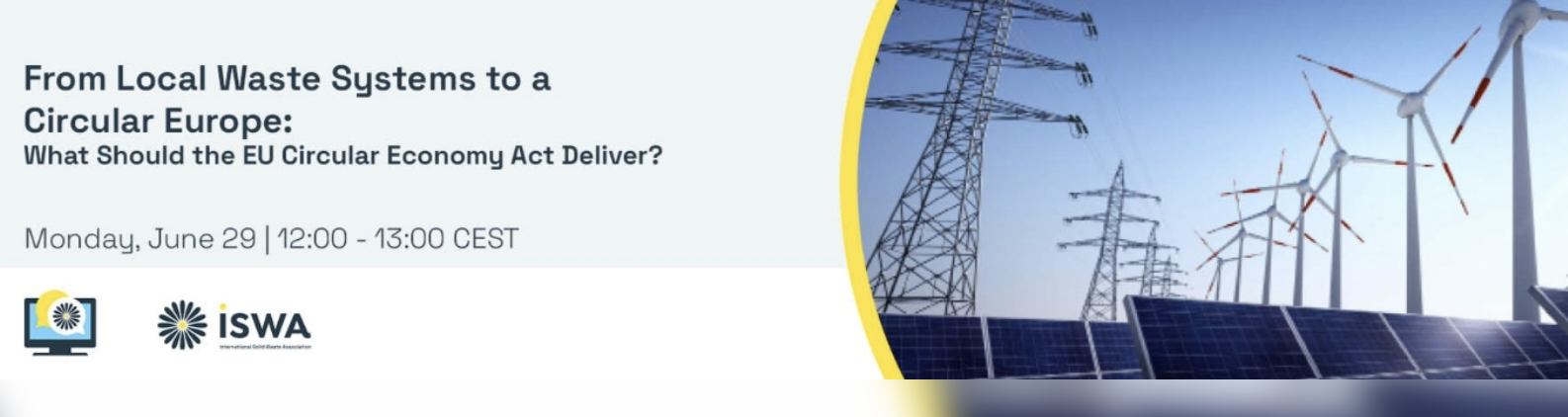
From Local Waste Systems to a Circular Europe: What Should the EU Circular Economy Act Deliver?

The European Commission is preparing a new Circular Economy Act, expected in autumn 2026. The Act is likely to become one of the key EU initiatives for the next phase of circular economy policy. It is expected to focus on strengthening the Single Market for secondary raw materials, improving the supply and demand of recycled materials, reducing fragmentation, and supporting Europe’s competitiveness and resource resilience.
For the municipal waste management community, this raises an essential question:
Can Europe create a functioning circular economy without strengthening the systems that collect, sort, treat and prepare waste for reuse, recycling and recovery?
Secondary raw materials do not appear automatically on the market. They are the result of functioning systems: separate collection, sorting, treatment, recycling, bio-waste management, residual waste management, data systems, financing, enforcement and citizen participation. Municipal waste management is therefore not only the “end” of the circular economy chain. It is one of its practical starting points.
Europe already has many circular economy targets and legal obligations. But the real challenge is implementation. Targets alone do not build infrastructure, reduce contamination, finance separate collection, create public trust, or guarantee stable markets for recycled materials. The Circular Economy Act should therefore help Europe move from circular economy ambition to circular economy delivery.
This ISWA EU Group webinar will discuss what the Circular Economy Act should deliver from a practical waste-management and implementation perspective. The discussion will look at how local waste systems, circular economy policy and producer responsibility schemes can better support Europe’s transition towards a circular economy.
Key questions will include:
- How can the Circular Economy Act support stronger municipal waste management systems?
- Where is EU harmonisation needed, and where must local flexibility remain?
- How can Europe improve the quality and reliability of secondary raw materials?
- How can collection, sorting, treatment and recycling systems be financed fairly and effectively?
- How can producer responsibility schemes support local waste systems without becoming the only answer to all circular economy challenges?
- How can the Act address free-riding, online sales and weak enforcement?
- How can the Circular Economy Act avoid becoming another layer of obligations and instead become a tool for practical implementation?
The webinar will bring together three complementary perspectives:
- ACR+ will contribute the local and regional perspective, focusing on what cities and regions need to implement circular economy policies in practice.
- Circulearth will bring a broader circular economy systems perspective, looking at how waste management connects with material flows, business models, data, traceability and secondary raw material markets.
- EucoLight will provide the perspective of producer responsibility schemes beyond packaging, drawing on the experience of lighting WEEE compliance schemes, collection challenges, treatment quality, free-riding and enforcement.
The central message of the webinar is:
No circular single market without strong local waste systems.
The Circular Economy Act should not only create a market for secondary raw materials. It must also strengthen the local waste-management and producer-responsibility systems that make those materials available, clean, traceable and usable.
Condividi evento
Take the Date è un prodotto di Nomos
Take the Date è il portale che promuove gli eventi istituzionali e pubblici di rilievo che si tengono ogni giorno in Italia. Nato da un progetto di Nomos Centro Studi Parlamentari azienda leader nel settore delle relazioni istituzionali.
Approfondimenti


















Iscriviti a Take The Date
Free
Gratis
- Consultazione di 8 eventi nella home page e nelle sezioni dedicate
- Iscrizione alla newsletter generica, che verrà inviata con cadenza settimanale
- Inserimento gratuito dei tuoi eventi
- Sponsorizzazione dei tuoi eventi (si applicano costi e condizioni)
Professional
€200/anno+IVA
- Consultazione di tutti gli eventi
- Iscrizione alla newsletter generica, che verrà inviata con cadenza settimanale
- Iscrizione a 2 newsletter tematiche
- Inserimento gratuito dei tuoi eventi
- Sponsorizzazione dei tuoi eventi con uno sconto del 10%
- Accesso all’archivio storico degli eventi
- Accesso all’agenda istituzionale
- Visualizzazione completa di tutti gli eventi nella Home Page e nelle aree tematiche
Enterprise
€300/anno+IVA
- Consultazione di tutti gli eventi
- Iscrizione alla newsletter generica, che verrà inviata con cadenza settimanale
- Iscrizione a tutte le newsletter tematiche
- Inserimento gratuito dei tuoi eventi
- Sponsorizzazione dei tuoi eventi con uno sconto del 20%
- Accesso all’archivio storico degli eventi
- Accesso all’agenda istituzionale
- Visualizzazione completa di tutti gli eventi nella Home Page e nelle aree tematiche
- Area riservata con calendario interno, archivio e alert personalizzati
- Copia/Incolla abilitato
Nato da un’iniziativa di Nomos Centro Studi Parlamentari - società di consulenza specializzata in public affairs, advocacy, lobbying e monitoraggio istituzionale e comunicazione - Take The Date è il primo portale che promuove tutti gli eventi di rilievo istituzionale e pubblico, che si tengono ogni giorno in Italia.